



To truly understand the metric system, you need to see how everything is connected by the number 10.
The cubic decimeter is the perfect "secret key" because it links length, area, volume, and mass together in one simple cube.
Why the Cubic Decimeter is Important?
The metric system is used in Canada and around the world, the units are "coherent," meaning they fit together like puzzle pieces:
Length: 1 decimeter is exactly 10 centimeters.
Area:1 square decimeter equals 100 square centimeters
Volume: 1 cubic decimeter is exactly 1 liter.
Mass: 1 cubic decimeter of water weighs 1kilogram.
The cubic decimeter is the perfect "secret key" because it links length, area, volume, and mass together in one simple cube.
Why the Cubic Decimeter is Important?
The metric system is used in Canada and around the world, the units are "coherent," meaning they fit together like puzzle pieces:
Length: 1 decimeter is exactly 10 centimeters.
Area:1 square decimeter equals 100 square centimeters
Volume: 1 cubic decimeter is exactly 1 liter.
Mass: 1 cubic decimeter of water weighs 1kilogram.
The Cubic Decimeter
(dm³)
The symbol (dm³) stands for a cubic decimeter.
The (dm) stands for decimeter and the small (³) tells you that it’s a cube.
The Cube
Learning about the cubic decimetre is just as important as learning your ABCs!
When you read and write, you use the alphabet to build words and tell stories. In measurement, you use the metric system. To really understand how it works, you need to build your own cubic decimetre. It’s the best way to see how math, science, and technology all fit together.
Think of the metric system as a "secret code" for the world. It shows you exactly how to measure anything, from the water in your bottle to the height of a skyscraper. Once you build this cube, the rest of the code will finally make sense!
(dm³)
The symbol (dm³) stands for a cubic decimeter.
The (dm) stands for decimeter and the small (³) tells you that it’s a cube.
The Cube
Learning about the cubic decimetre is just as important as learning your ABCs!
When you read and write, you use the alphabet to build words and tell stories. In measurement, you use the metric system. To really understand how it works, you need to build your own cubic decimetre. It’s the best way to see how math, science, and technology all fit together.
Think of the metric system as a "secret code" for the world. It shows you exactly how to measure anything, from the water in your bottle to the height of a skyscraper. Once you build this cube, the rest of the code will finally make sense!
dm³
The little three tells you that a metric cube measurement has length, width and debth.
dm²

The little two tells you that a metric polygon measurement has length and width.
The Metric System
Plastic Cubic Decimeter

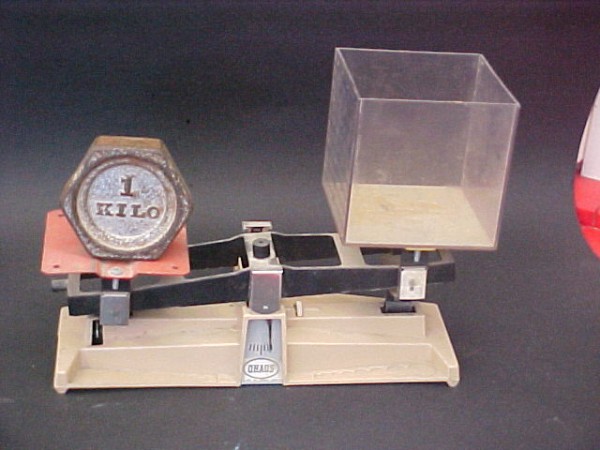
Fill the plastic cubic decimeter with water,
place it on a
scale opposite
to a kilogram
and the water will weigh
exactly one kilogram.
place it on a
scale opposite
to a kilogram
and the water will weigh
exactly one kilogram.
The Kilogram and The Cubic Decimeter
Kilogram
Let’s use the balance scale to see how the metric system works like magic!
A balance scale is a tool used to measure mass (how much "stuff" is in an object). It has two pans and a needle in the middle. When both sides have the exact same mass, the needle stays perfectly centered.
The Kilogram Connection
The standard unit for mass is the kilogram (kg). In this experiment, you will see how a kilogram of mass perfectly matches the water inside your cubic decimeter.
Step 1: Prep Your Scale
Every container has its own weight. To make the experiment fair, we have to "zero out" the weight of the plastic box first:
Place your empty cubic decimeter on one side of the scale. On the other side, add tiny gram weights until the needle is right in the middle. Now the scale is balanced, and we are ready to focus only on what we put inside the box!
Step 2: The Big Experiment
Now that the empty box is balanced, it’s time to see the connection between volume, capacity, and mass.
What you need:
A 1 kg weight
1 liter of water (add food colouring to make it easier to see!)
Your balanced cubic decimeter container
The Steps:
Place the 1 kg weight on the empty side of the scale. The scale will tilt way down because that weight is heavy!
Carefully pour exactly 1 liter of water into your cubic decimeter box.
Watch the needle. As the box fills up, the scale will slowly move back to the center.
What Did We Learn?
When the box is full and the scale is level, you have just proved the "Golden Rule" of the metric system:
1 Cubic Decimeter (Volume) =
1 Liter of water (Capacity) =
1 Kilogram of mass!
Everything in the metric system is built to fit together perfectly. Isn't that simple and fantastic and isn't MST great.
A balance scale is a tool used to measure mass (how much "stuff" is in an object). It has two pans and a needle in the middle. When both sides have the exact same mass, the needle stays perfectly centered.
The Kilogram Connection
The standard unit for mass is the kilogram (kg). In this experiment, you will see how a kilogram of mass perfectly matches the water inside your cubic decimeter.
Step 1: Prep Your Scale
Every container has its own weight. To make the experiment fair, we have to "zero out" the weight of the plastic box first:
Place your empty cubic decimeter on one side of the scale. On the other side, add tiny gram weights until the needle is right in the middle. Now the scale is balanced, and we are ready to focus only on what we put inside the box!
Step 2: The Big Experiment
Now that the empty box is balanced, it’s time to see the connection between volume, capacity, and mass.
What you need:
A 1 kg weight
1 liter of water (add food colouring to make it easier to see!)
Your balanced cubic decimeter container
The Steps:
Place the 1 kg weight on the empty side of the scale. The scale will tilt way down because that weight is heavy!
Carefully pour exactly 1 liter of water into your cubic decimeter box.
Watch the needle. As the box fills up, the scale will slowly move back to the center.
What Did We Learn?
When the box is full and the scale is level, you have just proved the "Golden Rule" of the metric system:
1 Cubic Decimeter (Volume) =
1 Liter of water (Capacity) =
1 Kilogram of mass!
Everything in the metric system is built to fit together perfectly. Isn't that simple and fantastic and isn't MST great.
Balance